Weinberg Entertainment leadership succession crisis
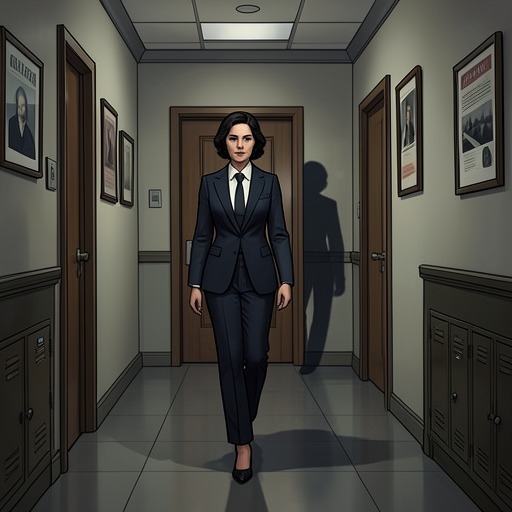
Robert B. Parker's WonderlandThe Weinberg Entertainment leadership succession crisis turns a succession clause into a contest over who can control the company, its projects, and the story told about its decisions. Jemma Fraser becomes CEO after Rick Weinberg’s death, but her formal authority does not settle her conflict with Rachel Weinberg or the questions raised by the coercion at Ocean View. The company’s transition is presented as orderly in its governance documents and increasingly unstable in its dealings with people inside and outside the organization.
Succession on Paper
Jemma explains that Rick came to see her not only in connection with the Revere project but to work out the company’s next move. She had not actually been fired: the claim that she had lost her job was a deliberate falsehood, used so the Ocean View condo board would sign the agreement. The deception makes the public account of Jemma’s employment part of the company’s negotiating strategy, rather than a straightforward record of who held authority.
The succession arrangement itself is explicit. Jemma says that if Rick died, she would take over as CEO, and that the board insisted on a clear line of succession. She also says Rachel voted for the promotion along with the other board members. The decision was therefore not, on the evidence available, a secret appointment imposed without Rachel’s participation. Yet consent to the appointment does not mean acceptance of what Jemma would do with the office.
Jemma describes her remit as extending well beyond the project in Revere: she says she is responsible for Las Vegas, Biloxi, and Macao as well, and now runs the whole company. She distinguishes Weinberg Entertainment from Envolve when asked which organization she leads. The breadth of that claimed responsibility gives the succession a practical dimension: Jemma is not simply a temporary representative for one local development, but the executive who says she directs the company across several projects.
Authority and the Ocean View Deal
The crisis is entangled with the Ocean View agreement. Jemma says the invented firing was meant to direct the residents toward signing, and she confirms that Rick was in a good mood because the deal had been made and Wonderland would become a reality. The sequence connects the company’s internal personnel story to an external property negotiation: the false account helped shape what the Ocean View residents believed while the agreement was being secured.
Jemma’s approach also reaches Spenser directly. She offers him twenty thousand dollars to leave the matter alone and walk away. The offer frames the dispute as something she believes can be managed through payment as well as through the company’s public-facing explanations. For Spenser, the offer is evidence that Jemma is not merely an executive whose appointment needs clarification; she is a participant actively trying to control scrutiny of the Ocean View affair.
Lewis Blanchard confirms another consequential part of that conduct. When asked whether sending the leg-breakers to the condo was Jemma’s idea, he says it was; the exchange also establishes that Rick did not know. Spenser then explains that Jemma said the company had lied about her firing to keep the Ocean View board focused in the right direction. Blanchard responds that the deception sounds characteristic of her, describing her as unable to stand not winning and saying she learned what she knows from Harvey Rose. His remarks are a character judgment, but his confirmation of her role in ordering the violence is a specific attribution of responsibility, not simply a general suspicion about the company.
Rachel’s Position and the Boardroom Fight
Rachel remains on the board after Jemma becomes CEO, but the difference between a board seat and executive control becomes central to their conflict. When Spenser asks about Rachel’s role, Jemma says she stays on the board while Jemma is CEO. The arrangement preserves Rachel’s formal place in the company while concentrating day-to-day leadership in Jemma’s hands.
Rachel’s account later shows that her earlier vote did not mean she anticipated the consequences. She acknowledges that she knew Jemma would succeed Rick and had voted for the arrangement because Rick wanted it. But after his death, Rachel says Jemma blindsided her on business matters and tried to turn the board against her. Rachel has just returned from a meeting in Las Vegas where she was offered a buyout and asked to leave the board in exchange for a check. She presents the proposal as an effort to remove her from company governance, not as a routine transaction.
The contrast is sharp: Jemma points to Rachel’s vote as evidence that the succession was approved, while Rachel points to the buyout and her treatment after Rick’s death as evidence that approval did not amount to agreement with Jemma’s later course. Rachel’s anger is immediate and physical; she pounds the armrest while describing how she has been blindsided. Her accusation that Jemma is making a mess of everything gives the corporate dispute the force of a personal rupture, while the proposed buyout supplies it with a concrete institutional stake.
Rival Claims and an Unsettled Outcome
Jemma casts the struggle in terms of the casino license. She describes Harvey Rose as ruthless and calculating and says that, with Rick dead, she is the only person standing between him and the license for East Boston. This is Jemma’s assessment of the threat, not an independently established account of Harvey’s intentions. It nevertheless clarifies how she presents her leadership: as a defensive position in a wider competition, one that she believes cannot be relinquished without consequence.
Rachel offers a competing claim to legitimacy. At breakfast, when Spenser suggests contacting Jemma because she is now running Rick’s company, Rachel says Jemma’s position is tenuous and insists that the people who trusted Rick will trust her. Her assertion does not undo the board’s succession decision, but it disputes the assumption that formal title alone guarantees authority. Jemma has the CEO position; Rachel believes she retains a source of trust that the title cannot automatically transfer.
The crisis therefore remains unresolved in the evidence presented. Jemma holds the office established by the succession plan, Rachel retains a board seat and contests the direction of the company, and the proposed buyout threatens to make that contest a question of exclusion as well as influence. Meanwhile, Spenser’s investigation links executive maneuvering to the concealed firing story, the Ocean View deal, and violence undertaken without Rick’s knowledge. The succession arrangement may have answered who would take over after Rick, but it did not settle who could be trusted, who controlled the company’s conduct, or whose account of its future would prevail.